In high-density industrial hubs like Maricopa County and the Goodyear logistics corridor, warehouse turnover costs have reached a critical tipping point due to labor mobility. Following the 2026 Arizona minimum wage adjustment to $15.15/hr, entry-level pay scales have compressed sharply heading into Q3 and the upcoming peak season.
For Operations Directors and Supply Chain Managers, this compression has introduced a volatile operational reality: The $0.75/hr Switching Threshold.
Our Q3 2026 regional workforce market analysis reveals that 15% to 20% of entry-level warehouse turnover is triggered by a pay variance of as little as seventy-five cents per hour.
The Anatomy of the $0.75 Tipping Point
In the West Valley logistics landscape, a $0.75/hr gap is no longer just a minor discrepancy—it is the exact economic threshold that motivates a reliable worker to leave your line for a competitor down the road.
When compressed minimum wage baselines meet rising personal commuting costs, workers actively calculate their daily net return. If a neighboring facility offers an extra seventy-five cents, the math clears: it offsets their fuel costs, and they jump ship.
The strategic blind spot for many operations is looking at this gap as a cost-saving measure. In reality, underbidding the market clearing rate triggers devastating financial metrics:
- Average Regional Tenure: Entry-level logistics tenure in Maricopa County has shrunk to just 10–12 weeks.
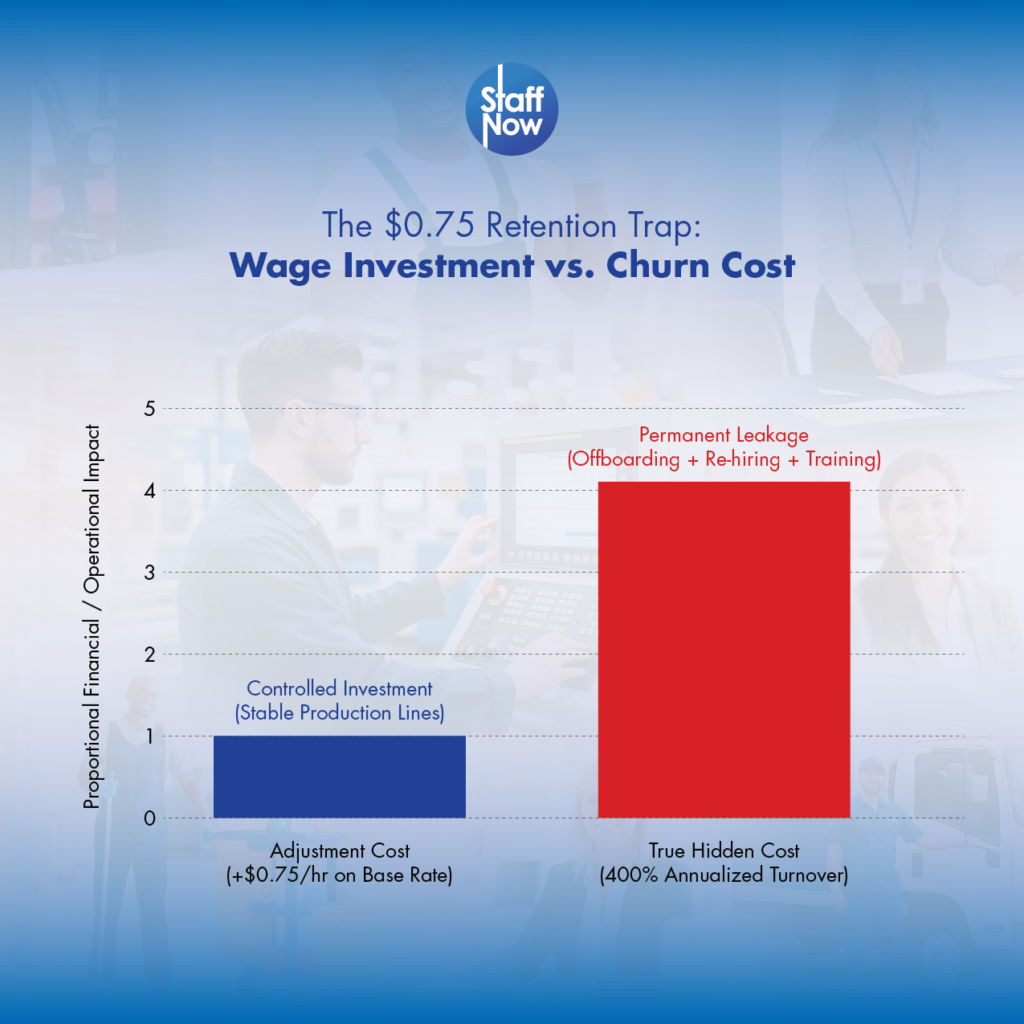
- Annualized Turnover: Facilities operating below the local market sweet spot are experiencing temporary labor turnover averaging 400%+ per year.
The Hidden Drainage: Constantly absorbing this churn forces operations into a permanent, costly loop of offboarding, rehiring, and retraining, destroying facility throughput and compounding your true warehouse turnover costs.
Breaking the Cycle: From Fixed Costs to Elastic Efficiency
Absorbing a 400% annual turnover rate is operationally unsustainable, especially when preparing for peak volume windows. To secure a 95%+ shift fill rate without permanently inflating fixed overhead or getting locked into rigid, high-base payroll structures, operators must shift their framework.
The solution requires a two-pronged operational adjustment:
- Target the Stability Zone: Base compensation must align with regional market realities to eliminate the baseline incentive to switch. (For general labor in Phoenix, this currently sits between $17.25 – $18.00/hr).
- Deploy Automated Workforce Elasticity: Instead of relying on traditional staffing agencies that push rigid, long-term headcount contracts, modern operators are leveraging agile recruiting ecosystems.
By partnering with StaffNow, facilities transition from a defensive hiring posture to an elastic model. Our automated recruiting and onboarding ecosystem grants instant access to an active, pre-qualified pool of local industrial talent. This allows logistics leaders to scale labor precisely around peak volume windows, mitigating the operational risk of the $0.75 switching gap while stabilizing the floor.
Operational Benchmark: Bidding beneath the market clearing rate risks a chronic 90%+ turnover rate on your lines. The facilities winning the Phoenix labor war in 2026 are combining targeted wage alignment with agile workforce technology.
Review the Regional Data
Ready to see exactly where your facility stands against the Goodyear and Maricopa County logistics corridors for H2 2026?
Contact our Phoenix Enterprise Team: Support@staffnowjobs.com | 1.602.283.3770
Note: In our upcoming market brief, we will release the complete H2 2026 Regional Wage & Retention benchmarks breakdown, mapping the exact percentiles for forklift operators, material handlers, and specialized logistics roles.