When managing headcount capacity, if your daily schedule shows 50 workers on the floor, it’s easy to assume your plant is operating at 100% throughput capacity.
In high-volume facilities, that assumption is a costly operational blind spot.
Matching your budgeted headcount on paper almost never translates to 100% performance on the floor. When operations teams treat static headcount as a direct proxy for capacity, hidden friction points quietly erode actual output—forcing your cost-per-unit through the roof.
The Illusory 100%: 2 Invisible Leaks in Headcount Capacity
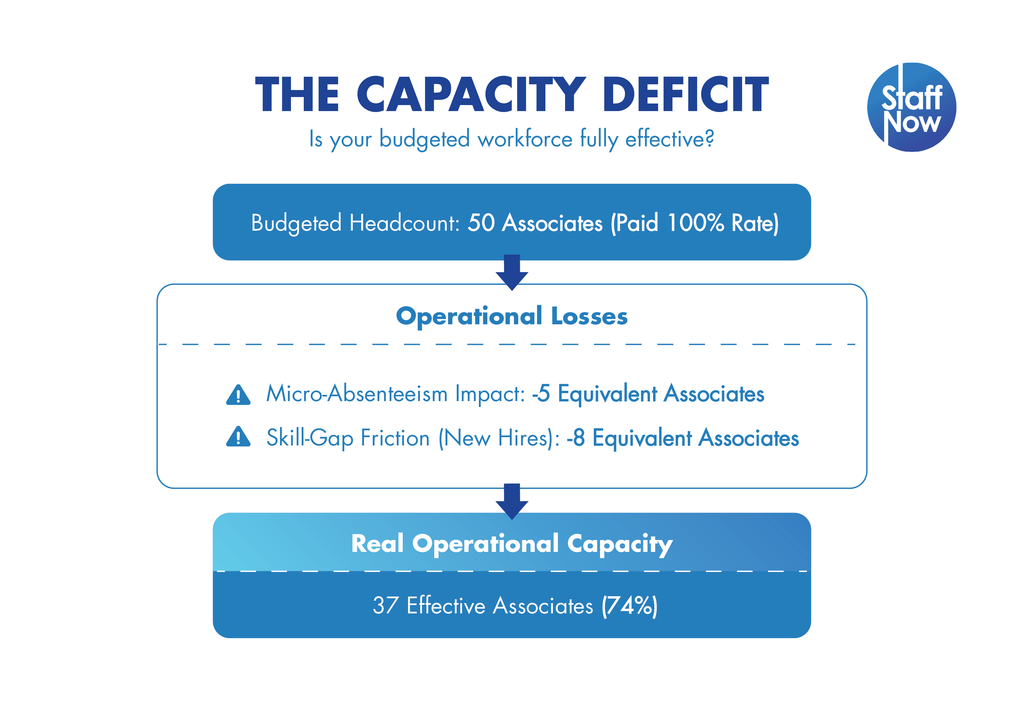
When a shift starts with 50 associates, hidden operational drag typically reduces your effective workforce to around 37 associates. Here is where those 13 “ghost workers” disappear:
- Micro-Absenteeism (8%–12% Loss): Late arrivals, extended breaks, and early departures disrupt line cadence, forcing supervisors to constantly reshuffle personnel mid-shift.
- The Skill-Gap Deficit (10%–15% Loss): A newly onboarded associate typically operates at only 50%–60% efficiency during their first two weeks. You are paying for a full seat, but receiving half the output.
The Overstaffing Trap vs. The Margin Squeeze
To cushion against these daily capacity leaks, plant managers usually resort to one of two flawed strategies:
- Static Overstaffing: Intentionally scheduling 55 or 60 workers daily to guarantee 50 show up and perform. This permanently inflates your fixed labor overhead.
- Absorbing Throughput Penalties: Running lean and missing daily unit targets, which leads to late delivery fees, missed SLAs, and expensive mandatory overtime.
Both options destroy profitability by increasing your Real Unit Labor Cost (RULC):
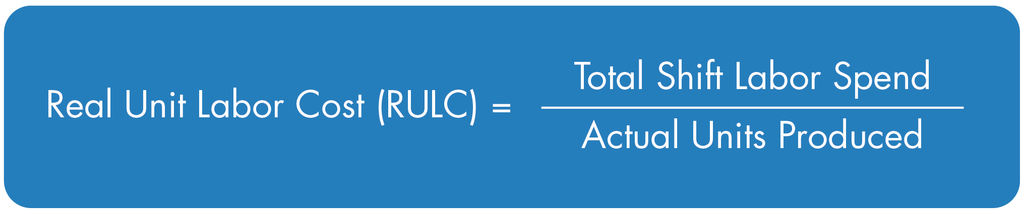
When your effective capacity drops from 50 to 37 associates while your total shift pay stays fixed, your real labor cost per unit jumps by 35%.
The Solution: Moving to Elastic Capacity
High-performing facilities don’t fix labor gaps by adding more administrative headcount—they build Elastic Capacity.
Rather than carrying massive static overhead, an elastic labor model structures your workforce into two layers:
- Core Baseline (70%–80%): Permanent, full-time personnel handling core operational continuity.
- Dynamic Surge Layer (20%–30%): Flexible, pre-vetted support deployed on demand to absorb volume spikes or bridge sudden shift deficits.
By deploying targeted 4-hour surge shifts or placing pre-evaluated specialists who operate at 100% line speed from day one, you keep line speeds consistent without carrying fixed payroll bloat.
How Healthy Is Your Floor’s Real Capacity?
Ask your team these three questions at the next operational review:
- Are we tracking labor costs based on scheduled seats or actual units produced per shift?
- How much throughput are we losing during the 14-day onboarding ramp of new hires?
- How much are we spending annually on static overstaffing just to cover absenteeism?
Stop managing your plant by headcount on a spreadsheet. Contact StaffNow to start engineering dynamic capacity that protects your cost-per-unit.
One thought on “Headcount Capacity: Why 100% Is Lying to Operations”
Comments are closed.